
World Food Day 2015 – taking a look at the current situation

Despite
positive development the UN Millenium Goal to reduce the number of hungry
people to 500 Million by 2015, has not been reached
The World Food Day always takes place on the 16th October and aims to draw attention to the millions of people worldwide that do not have enough food and go hungry. According to the World Hunger Report* by the United Nations the number of hungry people has decreased in comparison to the population increase, but there are still roughly 800 million people who do not have enough to eat and suffer from malnutrition.
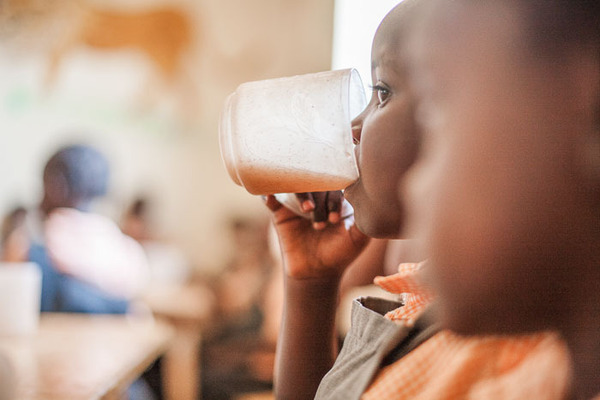
Hunger remains a worldwide problem
In the recently published World Hunger Index (WHI) the Welthungerhilfe (World Hunger Help) highlights that hunger has been decreasing since 2000. In total there has been a 27% decrease. However, in 52 of the 104 listed countries the hunger index is classified as “very serious” or “serious”. The majority of the eight countries with a “very serious” WHI values are located in Africa, to the south of the Sahara. According to estimates by the Welthungerhilfre malnutrition, which is the lack of vitamins and minerals in one’s diet that are needed to live healthily, affects more than two billion people worldwide. In Kenya there are also hundreds of thousands of people who go hungry and suffer from malnutrition – the so-called hidden hunger and the insufficient access to clean water. The country is currently on 67th on the WHI index. 21% of the population does not have enough food and the mortality rate of children under 5 is still over 7%.
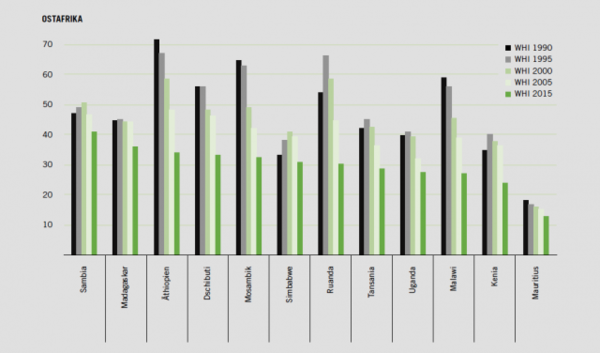
Causes of Hunger
The causes for hunger and malnutrition vary considerably depending on the country and the region. Especially in conflict regions the population has to struggle in extreme situations. Until now Kenya has been spared from war as far as possible, although attacks and military interventions at the border to neighbouring countries Somalia and Ethiopia are increasing, especially since the invasion of Kenya in Somalia in 2011. In Kenya poverty, especially in rural areas, is one of the main causes for hunger and malnutrition. Additionally, there are relatively high rates of HIV, although these are now decreasing. The province Nyanza in western Kenya in which the Nyota day care centres are located, is one of the areas with the highest rates of HIV in the country. Malnutrition in combination with HIV or AIDS often results in a deadly vicious circle.
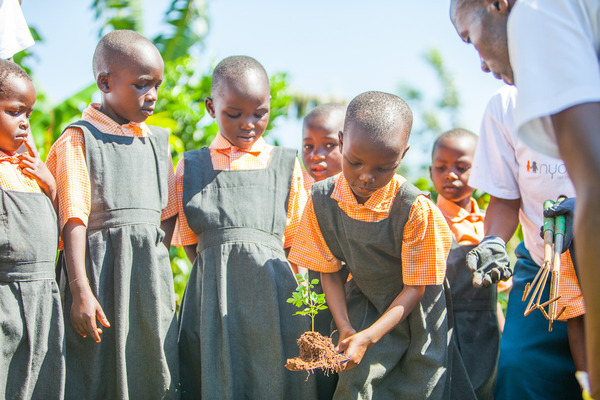
Supporting small-scale agriculture
In order to end starvation and malnutrition small-scale farmers need to be specifically supported. This is not just the conclusion drawn by the current World Hunger Report by the United Nations, but also the World Agriculture Report by the IAASTF that was presented in 2008 in Johannesburg. The latter reports that the normal industrial agriculture and its high use of energy, fertiliser, and pesticides is no longer appropriate. Instead, small-scale and ecological cultivation methods should be used to improve the situation. In Kenya (and many other African countries) agriculture plays a crucial role: 60% of jobs are in this sector (women make up 70% in this area), 60% of export earnings come from agriculture and 26% of the federal domestic product are generated here. Agriculture is Kenya’s economical backbone and is based on the efforts of many thousand Kenyan small-scale farmers. Therefore Nyota e.V. supports this development in the context of the project work in Kenya. Overall the ecological cultivation influences the living conditions of whole families and communities – it is a concrete help to self-help. Last year Nyota was able to pay for the orphaned Biko Collins to attend Baraka College and study sustainable agriculture and rural development in Molo due to donations via betterplace.og.

Self-sufficiency through subsistence economy
After the last drought and famine in 2009 Nyota began to cultivate the first fields in order to supply the day care centres and children with food. In regular community trainings and workshops pupils and small-scale farmers from the region are being included and schooled in sustainable cultivation methods in order to increase the yield and be able to feed their families. For this Nyota e.V. cooperates with other local charities for example the ICIPE or the BIOVISON Trust in Nairobi. Through this traditional knowledge is paired with new scientific knowledge and passed on to people in order to improve their situation. When choosing partners to cooperate with we pay attention to ensure that they put the interests of the people first and that they do not create new dependencies. Africa is an interesting market for global seed companies und agriculture companies. New hybrid varieties promise higher yields and resistance to disease – cue GMO. The consequences for humans and nature cannot be predicted. As tempting as a short-term increase in yield through genetically modified varieties may be, the long-term damage and the genetic pollution in the natural system can only be guessed at, let alone reversed. It is not seldom that small-scale farmers are forced into dependencies when buying new seeds (e.g. hybrid seeds) and enter into a vicious circle, which is neither supportive nor does it reduce poverty. The workshops are used to educate and pass on practical instructions.
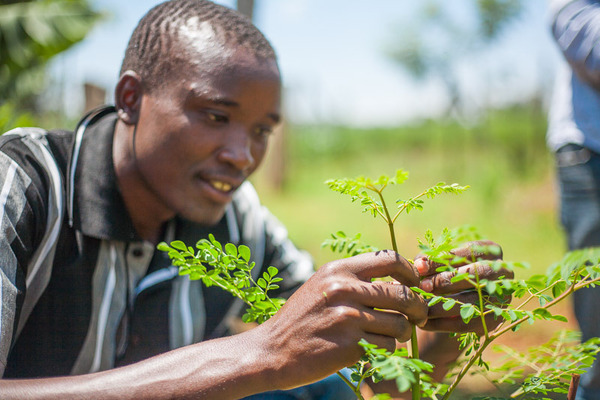
Moringa Oleifera or ‘the miracle tree‘
Recently one reads about superfoods in relation to western nutrition trends, however this is seldom in the context of a possible solution to reduce hunger and malnutrition. Superfoods are foods, especially fruit and vegetables that are healthier than others due to their high density of nutrients. Moringa Oleifera, a plant from the family of the horseradish tree, has a high level of nutrients and is such a superfood. It originally comes from the region of the Himalayas and the fast growing tree has spread worldwide since. Moringa Oleifera has a (naturally) uniquely high level of nutrients and grows in areas where hunger and malnutrition is prevalent. In many traditional folk medicines it is valued for its healthy properties and now in western countries scientific studies and findings about the plant are increasing. At Nyota this tree has been increasingly planted in the Organic Green Garden since last year. Since then it has been part of the daily menu in the day care centres. We already documented the cultivation, meaning and use of Moringa in order to benefit the children (Link zum Beitrag). A current goal for Nyota is to increase the cultivation of Moringa and to draw attention to the tree in local communities and encourage them to also plant the tree.
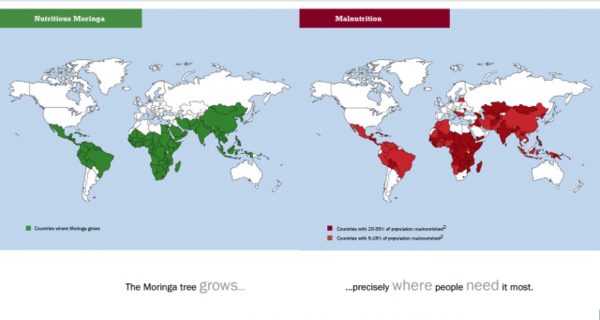
Picture left in green: Moringa Oleifera grows here! | Picture right in red: Countries and regions in which people go hungry and suffer from malnutrition
Help Nyota help
You can also help, for example with a donation and by sponsoring John to go to College and study sustainable agriculture. 19 year old John Okolla, an orphan who has been supported by Nyota for over 10 years, wants to go to the Baraka College in order to deepen his knowledge about sustainable agriculture and subsequently use his knowledge to help the local community. The study course takes 2.5 years and costs 2,300€ including board. He will spend the practical semester with Nyota in the cultivation project, in which John has been working since the beginning of 2015. Nyota desperately needs experts in order to expand the cultivation projects and community workshops, therefore he will definitely be employed afterwards.
Read the article ‘Morgina for Lwala and the day care children’
* The World Hunger Report is published by three UN-organisation: FAO (Food and agriculture organisations), the IFAD (International Fonds for agricultural Development) and the World Food Programme (WFP). It can be downloaded here. Sources: World Food Programme, UNESCO, tagesschau.de, treesforlife.org