
life slum dwelers-2
a. jahangir wrote on 17-11-2014
"It is very alarming � a growing emergency. This could be very dangerous. The predictions for the future are that by 2030, Bangladesh will have an eight percent prevalence rate among all adults, which is enormous.
"Dhaka is likely to see the first outbreak and the first spike will be with injecting drug users, and the second � in 2010 � will be client-driven, through sex work, especially as many sex workers� clients are drug users. These groups are at risk not just of contracting HIV themselves, but of passing it on to others." Needle exchange CARE International runs 52 drop-in centres in Dhaka � some of them through local non-governmental organisations. The centres are used by about 10,000 injecting drug users, 50,000 heroin smokers and other drug users - who are at risk of starting to inject - and 20,000 sex workers. Recent figures show these programmes reach 75 percent of Dhaka�s drug users and more than 85 percent of its sex workers. Each centre has a trained nurse, HIV support and education, opportunities to detox, free condoms and a needle exchange programme. People can also wash, eat, watch television or learn a vocational skill. Former drug user Faruk Hossain, 25, who lives in the Colony, is an outreach worker for CARE, visiting hotspots to tell users about the dangers of HIV and explain how they can change risky behaviour. He also exchanges used syringes for clean ones and hands out condoms.
 "There was a heroin spot around my house, with people taking drugs all the time," he said. "From my childhood, I saw them, and when I got older I started taking heroin too.
Location of the Slum’s.

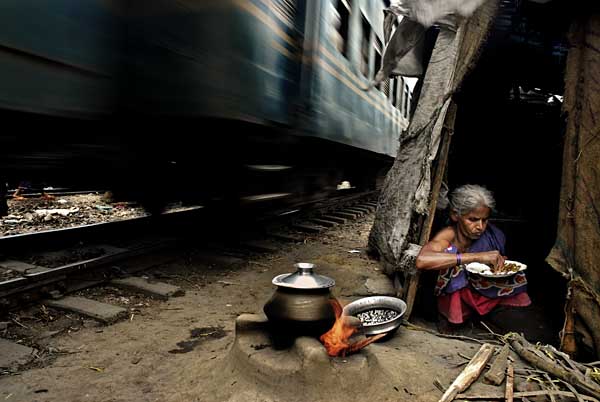
Most of Slum’s of Bangladesh is situated in Government land and land of railway department is one of the most common location of Slum’s. Slum’s are growing rapidly, now 19.4% of total population of Dhaka City lives in the Slum’s and lack of government officials presence and activeness are main reason working behind the growing Slum’s of Dhaka City in the Government Property. This photo was taken from sides of Khilgaon Flyover, where many slum’s are taken place as there are no one to prevent them from such illegal action.
No Specific Place for Washing and Cleaning Dishes.

Slum’s situating near the Komolapur Rail Station donot have any specific place for cooking, washing, cleaning. So it is found that the Slum people are doing their washing and cleaning along with cooking under the open sky which is pretty bad for their health. Reagdling of this fact most Slum’s do not have a proper access to safe water which is the main reason for water diseases which is occuring to the children mostly.
Absence of Gender Discrimination.

People like us love to maintain particular time table for having our breakfast, lunch or dinner. But people living in Slum’s donot have any time table for having breakfast, lunch or dinner. Slum people only have their meal when ever they are able to cook that and cooking of meal depends on generating income or on earning money. So unless they are able to earn money they can not hope for having meal. So after knowing some facts like this I feel very lucky and very sad at the same time. I feel lucky because i donot have to waite to earn to have my meal and I feel sorry and sad after knowing childrens who are younger than me have to earn first every day to ensure meal every day.
One Room Palace

I was quite surprise to know six people live in this room. A man name Hossain Mia and his wife Suraiya came to Dhaka from Dinajpur with their four children and rented this Slum. Hossain Mia works as a rickshaw puller and his wife works as a part time servant. His Eldest son is a newspaper vendor in the bus stop. So, to me this slum is like a palace which contain only one room and people like them is quite happy to have a shade over head.